Why I Gave It Its Own Account
Robinhood opened agent trading in 2026 over MCP, the same protocol Claude uses to reach any other tool. The part that made me comfortable was not the agent. It was that agent trading happens in a separate account you fund on purpose, and the agent cannot reach anything else you own.
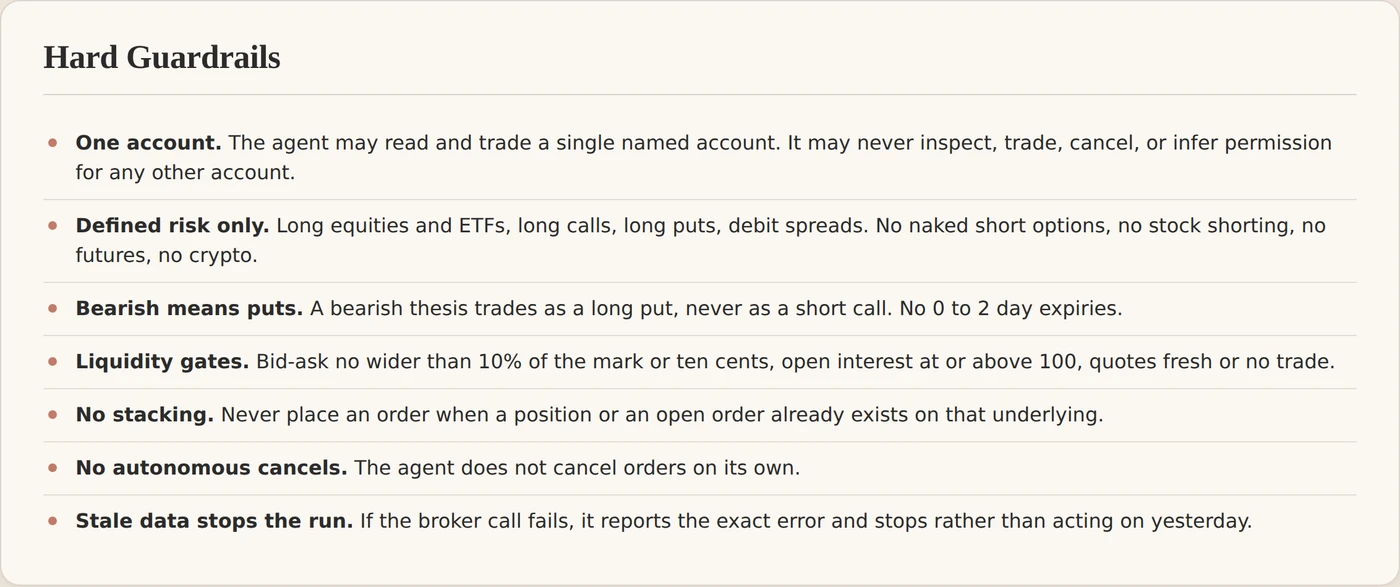
So the very first rule I wrote was not about strategy. It was an account number, hardcoded, with an instruction never to inspect or trade anything else. Everything after that is damage control on a bounded amount of money.
Robinhood is blunt about the rest. You can authorise an agent to trade without confirming each order, and you assume all risk for what it does. I agree with them. That is the deal, and it is the reason the rest of this page exists.
What The Agent May Never Do
- Touch any account other than the one named in its instructions.
- Hold anything with an unbounded loss. Long stock and ETFs, long calls, long puts, debit spreads.
- Short a stock or sell a naked option. A bearish idea trades as a put.
- Buy an option expiring inside two days, or one with a wide spread and no open interest.
- Add to an underlying it already holds, or cancel an order on its own.
- Act on stale data. When the broker call errors, the run stops and reports the error text.
None of that is clever. It is the difference between a bad day and a bad month.
How The Loop Runs
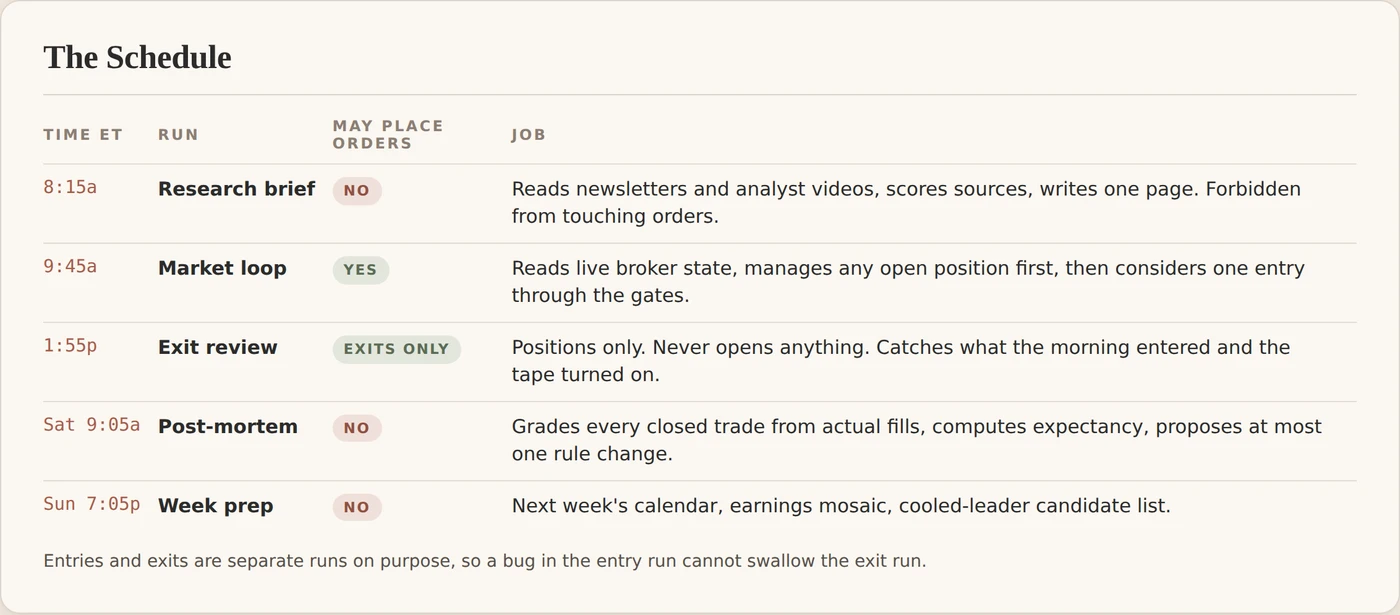
Five scheduled runs, each with one job. The two that may place orders are the two carrying the most rules.
01 It reads the broker state, then the tape
The entry run starts by pulling live positions, open orders and buying power from the broker. Not a cache, not the morning research page. If that call fails, the run stops there and says so. Every decision after that point is made against a state I can reconstruct later.
02 It manages what it already holds, then looks at anything new
Open positions get handled first, against the exit model, every single run. Only then does it look at candidates, and only when nothing is already open on that underlying. An agent that hunts for new trades while an old one bleeds is just an expensive optimist.
03 It has one sizing decision, trade or no trade
A candidate that clears every gate gets the full allocation. A candidate that misses one gate gets nothing. No conviction tiers, no half sizes, because tiering is how you take a trade you already decided against.
That only works because the account itself is the position sizer. It holds an amount I can lose without it changing anything about my week, which is the honest version of risk management at this size.
04 It reviews exits again at 2pm
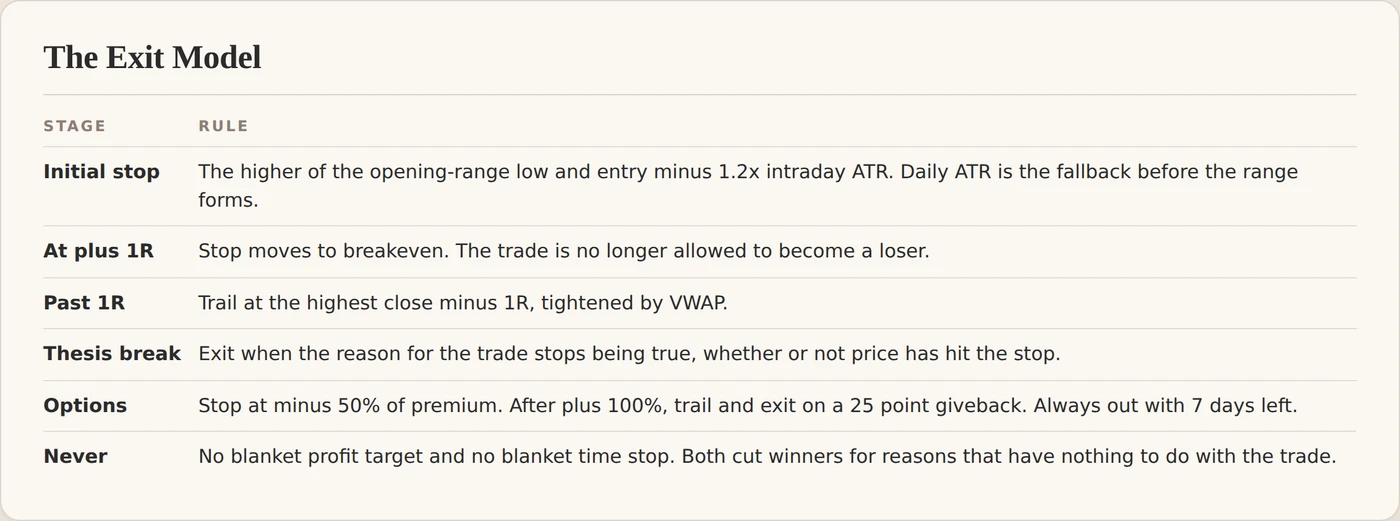
The afternoon run never opens anything. It only looks at what is already held and applies the same exit model to fresh quotes. That run is why a position entered in the morning does not sit unattended into the close on a day the tape turns.
05 It logs every run, including the quiet ones
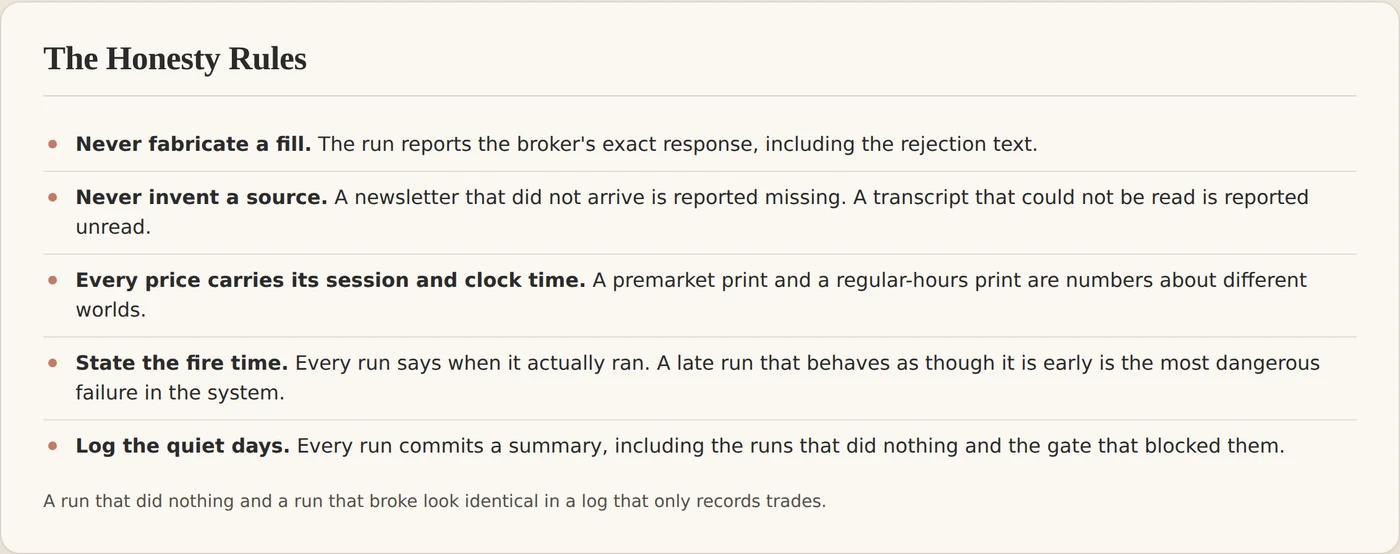
Every run commits a summary, whether it traded or not, with the gate that blocked it when it did nothing. A quiet day and a broken agent look identical in a log that only records trades.
Then a weekly run grades every closed trade against the actual fills and computes expectancy. That is the only part that can tell me whether any of the rest of this is worth running.
The Part That Does The Work
Most of the instructions are not strategy. They are the list of things the agent is not allowed to do, written plainly enough that a run can be held to them.
# The first rule, and the only one that bounds the damage
ACCOUNT one account, named by number in the instructions.
Never inspect, trade, cancel, or infer permission
anywhere else. Never move money.
# What it may hold
ALLOWED long equities and ETFs, long calls, long puts,
debit spreads. Max loss known at entry.
NEVER naked short options, short stock, 0 to 2 DTE,
anything with an unbounded loss.
# When it may not act at all
- A position or open order already exists on that underlying.
- The quote is stale, or the broker call errored.
- The tape is broadly risk-off.
- No candidate cleared every gate. Cash is a position.
Straight from the run instructions, with the account number removed. The whole rule set is in the free download.
What Changed
The decisions now get made while the market is closed. The agent does not get to renegotiate a stop at 11am because a position is red, and I do not get to either, because the rule is written down and the run reports what it did.
No performance claims on this page. It is a rule set and a schedule, not a track record, and none of it is advice. An agent that follows every rule here can still lose money, and the person who signed up for that is me.
Get The Guardrail Template, No Charge
The rule set above, templatized, with everything of mine stripped out. There is no order-placement code in it on purpose. You bring your own agent and your own broker connection, and point it at these.
- account-lock.md The one rule that bounds the blast radius
- instrument-limits.md What it may hold, and what it may never hold
- entry-gates.md What has to be true before anything opens
- sizing.md The only sizing decision worth having
- exit-model.md Stops, breakeven, trails, and the option rules
- schedule.md What each run of the day may and may not do
- honesty-rules.md The rules that stop a confident lie
- grading.md How you learn whether any of it works
No email, no signup. The numbers in it are one person's risk tolerance on a small account, not advice. Change every one of them before you point anything at a live account.
Who This Suits
Worth your time if you are about to connect an agent to a live brokerage account, or you already did and have not yet written down what it may never do.
Skip it if you want a strategy or a signal. There is neither here, and nothing on this page is financial advice.
And if you would rather not build it yourself