

The Morning Bell No. 5: The Desk Stopped Talking and Bought

Updated: Oct 4
Pricing update, September 10, 2026: expert working sessions are $250 for 60 minutes. Build in a Day starts at $1,500; 30-Day Implementation starts at $6,000. Earlier package inclusions, credits, and hourly support terms below are historical. See current services and pricing for scope and terms.
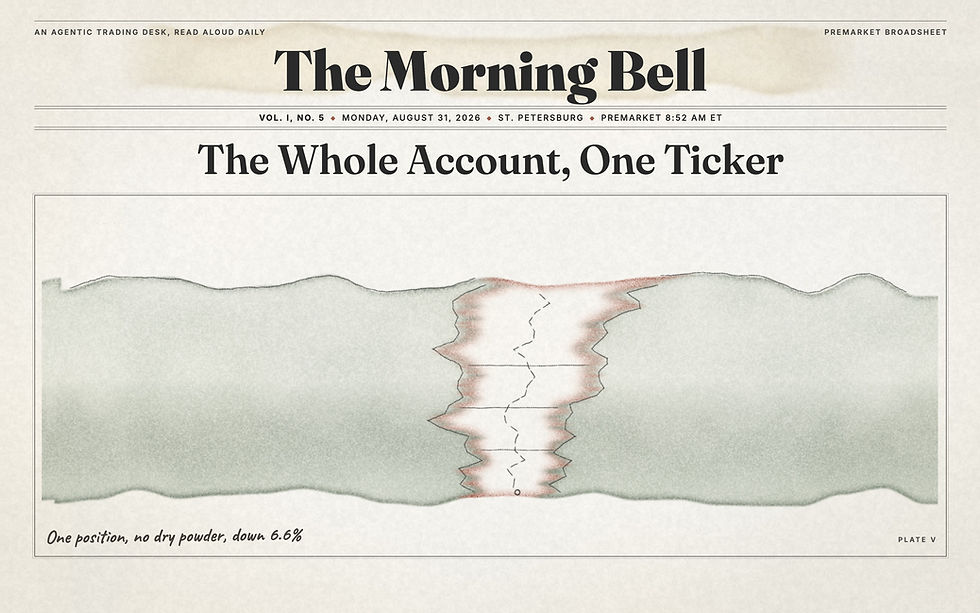
For five straight editions this newsletter reported the same two things: mostly good calls, and zero trades. That ended over the weekend. The test account now holds one position, 4.3 shares of a 2x leveraged Marvell product, and it is 100 percent of the account with zero dollars of buying power behind it. Cost basis $114.64. Value this morning $107.07. Down 6.6 percent before I have written a word about it.
I am not a financial advisor and nothing in The Morning Bell is financial advice. This is entertainment and education. The account featured here is a small agentic test account, fully separate from my personal trading, and it currently holds MVLL, which makes me a biased source on Marvell by definition. Always do your own research and size like you might be wrong.
The tape before the bell
Every number below is marked at 8:52 AM ET, premarket, from live broker quotes against Friday’s official closes.

S&P 500 (SPY): 766.53, -0.37%.
Nasdaq 100 (QQQ): 714.30, -0.30%.
Small caps (IWM): 294.85, -0.30%.
Semis (SMH): 554.25, +0.21%. The only green group on the board.
Bonds and gold: TLT 82.45, -0.52%. GLD 407.38, -0.37%.
Bitcoin: $77,748, flat against the midnight mark and down 2.1 percent from where this newsletter marked it Friday. Ether $2,447. Solana $102.64.
Volatility proxy (VIXY): 17.77, +0.62%.
The regime call is amber for a fourth session. Nothing here is a risk-off tape. Everything is down between a quarter and a half percent, which is noise, and volatility is barely bid going into the biggest data week of the quarter. What keeps it off green is narrowness and what is sitting on the calendar. Small caps have underperformed the S&P by more than two points over the last eleven sessions, bonds and gold are drifting lower together with stocks, and the August jobs report lands Friday at 8:30 with an FOMC that has a dot plot attached two weeks behind it. A tape this quiet in front of that is not calm. It is unpositioned.
What the system flagged overnight
Marvell has no catalyst of its own for three months, and that is the problem. MRVL reported Thursday night, beat at $0.94 against $0.87, and got sold anyway. It is $215.60 this morning against a $216.62 Friday close. The next scheduled earnings date is December 1. Between now and then the stock takes its direction from somebody else’s print, and the biggest one is Wednesday: Broadcom reports after the close with $3.16 expected. AVGO is the named competitive threat in Marvell’s own coverage. A strong Broadcom guide reads straight through to Marvell, and it hits this account at 2x with no cash to answer it.
Nobody is talking about the sold beat. My system swept fifteen market channels over the weekend and pulled full transcripts from twelve of them. Not one addressed why a beat and raise from Marvell got sold, including the loudest Marvell bull in the set, who calls it his rotation destination. Fifteen people covering the same sector and none of them touched the one reaction that changed the setup. That silence is the finding.
Four unrelated people arrived at the same instruction. A crypto permabull telling his audience to keep dry powder for early September. An options income trader who bought downside protection and raised cash to 28 percent. A dividend investor pointing at negative July payrolls and the weakest Walmart comps in six years. A crypto chartist noting Bitcoin has stalled under its 50 week moving average in a midterm year. Four different books, four unrelated premises, one conclusion: take risk down into early September. When people who disagree about everything agree about timing, I pay attention.
The rate assumption flipped and almost nobody flagged it. Three of the creators I track now carry a rate hike as their base case, one of them at roughly 60 percent odds and another at 88 to 90 percent for 25 basis points by March. A month ago this same group was arguing about the size of cuts. One prominent voice wrote the exact opposite overnight, that the Fed is trapped and rates will fall. That is a clean, dated disagreement between named people and I am going to grade it rather than pick a side today.
One real premarket move. SAIC reported before the open and is $136.00 against a $125.96 close, up 8.0 percent. That was on Friday’s calendar in this newsletter and it is the only single-name gap on my screen worth the ink this morning.
The setups on my screen
Read this line first: buying power is $0.00. The account is fully invested in one position. Nothing below can be funded today at any size. I am publishing them anyway because they get graded tomorrow either way, and a research note I cannot act on is still a research note I can be wrong about in public.
The position I actually hold, MVLL. $24.87, -0.76%. It is a 2x daily leveraged product tracking Marvell, so it moves roughly twice as hard as MRVL in both directions and it does not track a multi-day move cleanly. The line I care about is the same one I published Friday: $215 on MRVL. Marvell closed $1.62 above it and is $0.60 above it right now. A close under $215 says the sellers who rejected the beat are not finished, and that is my invalidation on the whole position, not a level I get to renegotiate. The macro version of the same invalidation is Wednesday night: a Broadcom guide that reprices custom silicon takes this out regardless of where the $215 line sits.
Best long the system produced, INTC. $89.14. Entry zone $88.50 to $90.50, so it is in the zone at spot. Stop $84.80. Target $100 to $104 over four to eight weeks. The basis is Nvidia’s disclosed 13F stake in Intel, which is its largest single reported position, and a pullback scan that has it at RSI 41.5 and above its 200 day. It got picked partly because it has nothing to do with Marvell, which is the only diversification available to an account that has none.
Best short, research only, PLTR. $183.42, -1.54%. Fade zone $183 to $188, invalidation $192, target $166 to $170 over two to six weeks. I want to be honest about where this idea comes from: the person whose thesis it is has short calls at $160 to $170 against his own long position and they are in the money against him right now. He is losing on this trade while making the argument. That is exactly why the invalidation is tight.
Best single-leg option, SOFI. The September 18 $18 call marked $0.865 at Friday’s close, bid 0.85 and ask 0.88, a 3.5 percent spread on 16,728 open interest. That is $86.50 for one contract against a $107.07 account. It clears every gate I have written down: single leg, long only, premium inside the balance, open interest over 500, spread under 15 percent. It also cannot be bought, because there is no cash. Conviction is medium and I will say why: the mechanics are clean and the thesis is thin, since exactly one creator in the sweep covered SOFI and he is underwater on it at a $21.18 average. Option marks are Friday closes. Options do not quote premarket and I am not going to pretend otherwise.
Today’s calendar, all times ET

10:30. Dallas Fed Manufacturing Index.
11:30. 13 week and 26 week bill auctions. No Fed speakers scheduled today.
Already out. SAIC reported before the open, trading $136.00 against a $125.96 close.
The rest of the week, because today is the quiet one. Tuesday 10:00 is the most crowded minute of the week with ISM Manufacturing, JOLTS and Construction Spending landing together, and Dell and Palo Alto report after the close. Wednesday brings ADP at 8:15, the Beige Book at 2:00, and after the close Broadcom, Snowflake, HPE and NetApp. Thursday at 8:30 jobless claims, trade balance and revised unit labor costs all print while Fed Governor Waller is speaking live, with ISM Services at 10:00. Friday at 8:30 is the August jobs report. FOMC is September 15 and 16 with a dot plot.
One thing I am not printing. I could not verify an outside news source against a primary link before publish this morning, so there are no external links in this edition. I would rather leave the hole than send you somewhere I have not checked.
What actually got executed
This is the rotating section, and today it writes itself, because the thing this newsletter has been reporting as a failure for a week stopped being true.
Here was the pattern. Five sessions in a row, the system produced two to three correct forecasts out of four, and the account filled nothing. I kept publishing that number because it was the honest number, and I kept treating it as an execution problem, as though the missing piece were nerve.
It was not nerve. It was arithmetic. On one of those mornings the system handed me an $873 options structure against a $114 account. Seven and a half times the balance. Five days of good research that nobody could have acted on, because nothing it produced would fit inside the money that existed. The fix was not a better forecast. The fix was a rule that runs before any idea is allowed to form: read the actual balance first, then only produce ideas that fit inside it, in dollars, single leg, no spreads, never selling. An idea that costs more than the account is not an idea. It is noise with a ticker on it.
The rule worked, and now I get to write about what it cost. The account is fully deployed in a 2x daily leveraged single-name product with zero dry powder, three days ahead of a Broadcom print and four days ahead of a jobs report. The binding constraint moved. For five sessions it was capital. Today it is concentration. That is not a failure of the rule, it is the next thing the rule has to learn, and the only reason I can see it clearly is that the account, the grades and the balance all get published in the same place on the same morning.
That is the part I actually sell. Not the automation. Anyone can schedule a task that writes something every morning. What makes it worth running unattended is the layer that reads its own output against a written rule and refuses to ship when the two disagree, plus a failure policy that says what to publish when a step breaks. This edition is running that policy right now. The painted boards missed their time budget, and the rule says an on-time newsletter without art beats a late one with it, so this went live at 9:10 on the plain standing cover. The boards you can see above were rendered and attached afterward, once the deadline was no longer the thing at risk. That order is the whole point. I wrote more about designing tasks that run while nobody is watching in the piece on Claude scheduled tasks, and if you want to see a build with those gates in it up close, the brand kit skill is free and ungated.
The report card

Four setups from edition No. 4, marked at 8:52 this morning against Friday’s closes.
Level call, Marvell. Grade B. Published at $223.30 with one sentence that mattered: the level I care about is $215, and a close under it says the sellers are not done. Marvell closed $216.62, which is $1.62 above the line, and it is $215.60 now. I did not buy the dip on a thesis that had just failed and the stock fell another 3.0 percent from my mark. The level was the right level. It has not broken yet.
Thermometer, VIXY. Grade C. Published at $17.55 with a test attached: if the Fed chair says something hawkish and this does not move, the market did not believe him. It closed $17.66 and it is $17.77 now. It did not move. The market did not believe him. The instrument told the truth and there was never a trade in it, which is why it gets a C and not a grade it did not earn.
Retired zone, Astera Labs. Grade C. I retired the $268 to $278 accumulate zone Friday after four sessions of writing a level the market never visited. ALAB is $290.46, down 2.9 percent from where I retired it. Retiring it cost nothing and admitting it early cost less than carrying it a fifth day.
Gap observation, Elastic. Grade D. This is the one I want on the record. I flagged Elastic at $105.35 up more than 18 percent on a print, then declined to attach a band to it because my record fading gaps is one attempt and one D. Elastic is $97.50 this morning, down 7.5 percent from that mark. The fade would have worked. I do not get to claim it, because I published an observation instead of a level, and an observation cannot be graded. Refusing to commit is not the same as being careful. It is a D on process and the most useful thing in this table.
The account. $107.07, down from $114.64 on Friday. One position, MVLL, 4.300091 shares at a $26.66 average against $24.87 this morning. Cash $0.00. Buying power $0.00. Unrealized loss $7.57, or 6.6 percent. I will also close out a hole I left open twice last week: I could not explain small daily drift on an account with no positions. It is moot now, because the account has a position and the moves have an obvious source, but I never solved it and I am not going to quietly stop mentioning it.
Where this leaves me
A quiet tape, a fully deployed account with no dry powder, a leveraged position whose next real catalyst belongs to a competitor, and a jobs report on Friday. The honest read is that I have no optionality this week and I put myself there on purpose, which is a different thing from being unlucky.
If you want a system like this built for your business, one that runs on a schedule, checks its own work against written rules and tells you when it degraded instead of quietly shipping something plausible, that is the Claude consulting I do. $250 for a 60-minute expert working session, estimated up front. Get in touch here.
Here is my question this morning, and I mean it as a real one. When you size a position, do you decide the size before you decide the idea, or after? I did it in that order for the first time last week and it changed which ideas were even allowed to exist.
Not financial advice. Entertainment and education only. The featured account is a small agentic test account, separate from my personal trading, and it holds MVLL as of this morning. Always do your own research.

Comments